
Are Motorized Screens Worth It for Durability and Daily Use?
A closed, well-fitted motorized screen can keep mosquitoes and other bugs out while preserving a view of the lake or tree line. Whether motorized screens are worth it depends on how often you use your outdoor space and how much you value on-demand shade and convenient operation. They’re a practical choice when you want to open or close a screened area without handling the screen by hand.
Weigh that convenience against everyday durability, especially in Muskoka, where a season can bring sun, rain, insects, and gusty weather. A screen can make a porch or covered deck more comfortable, but its performance depends on keeping the mesh intact and lowering it when you need protection.
This article explains how motorized screens can help with bugs and sun, what to consider about weather exposure and regular use, and how power needs affect installation. You’ll see where motorized operation can make outdoor living easier, what can affect a screen’s lifespan, and when a simpler screen may suit your space better.
Key Takeaways
- See how a well-fitted screen can help keep insects out while preserving your view.
- Learn why wind exposure and retracting screens when they’re not needed matter in changeable Muskoka weather.
- Understand which material and climate factors can affect screen life and maintenance.
- Weigh the convenience of motorized operation against the need for a power source.
- Consider how your opening, outdoor routine, and preferred level of shade shape the right screen choice.
Protection from weather and UV damage
A fitted screen can help keep mosquitoes and other insects out of a Muskoka porch or deck. When lowered across an opening, the mesh creates a barrier while preserving views of the lake or forest. Gaps at the sides or bottom can leave entry points, so a good fit matters. Screens are not sealed walls and won’t exclude every insect in every condition.
Sunlight brings another consideration. Retractable shade fabrics provide UV protection and solar shading, and are available in 20 designer colours. The fabric can soften direct sun on a west-facing deck during late summer afternoons. It may also reduce glare on a dining table or seating area. The amount of shade depends on the fabric and how much of the opening it covers.
A lowered screen can also shade patio furniture from direct sunlight. For example, covering a seating area may reduce sun on cushions and tabletops during the brightest part of the day. It doesn’t make furniture weatherproof: rain can still reach an open-sided space, and damp cushions need suitable care. A screen provides shade, not a substitute for storing or covering furnishings.
Retractable screens let you respond to changing weather. Raising them when they’re not in use helps protect them from the elements. In gusty conditions, a wind sensor can help prevent damage by retracting the screen during high winds. This can matter on exposed decks near open water, where conditions may shift quickly. A sensor offers added protection, but it doesn’t make a screen suitable for every storm.
- For insects: Lower the screen across the opening and keep its edges aligned with the frame.
- For sun: Choose a fabric and screen position that suit the sun’s path and your preferred light.
- For wind: Consider a wind sensor and retract the screen when it’s not in use.
Privacy depends on the fabric and lighting. A lowered screen can create a softer visual boundary from nearby properties while keeping outdoor surroundings in view. It isn’t a solid privacy wall, and visibility can change between day and evening. Before choosing coverage, consider sightlines from neighbouring decks.
If you’re weighing how screens could suit a porch, deck, or cottage opening, explore motorized and manual screen options for Muskoka outdoor spaces. Match the screen’s use to the conditions it will face: insects, direct sun, wind exposure, and the care of furniture all shape its day-to-day value.
Screen durability and lifespan
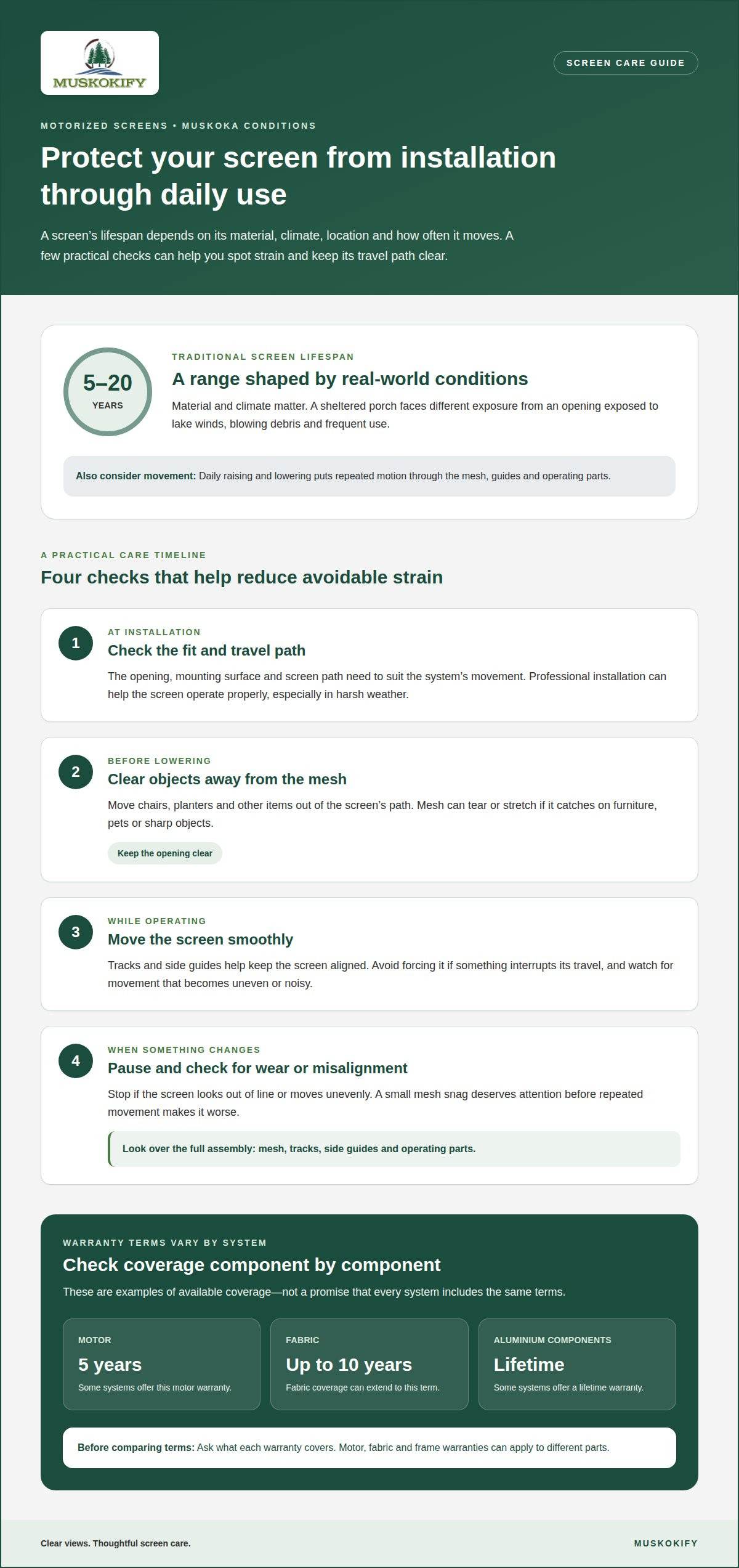
Screen life depends on more than the mesh. Traditional screens typically last 5-20 years, depending on material and climate. That range shows why a screen’s location and exposure matter. A sheltered Muskoka porch faces different conditions from an opening exposed to lake winds, blowing debris, and frequent use. Daily raising and lowering also puts repeated movement through the screen, its guides, and its operating parts.
Assess the whole assembly, not just the fabric. Mesh can tear or stretch if it catches on furniture, pets, or sharp objects. Tracks and side guides need to keep the screen aligned as it moves. For example, a chair pressed against the mesh can cause avoidable strain. Keep the opening clear and operate the screen smoothly to reduce that risk.
Warranty terms vary across motorized systems, so read coverage by component. Some systems offer a 5-year warranty for motors, fabric warranties of up to 10 years, and a lifetime warranty for aluminium components. These are examples of available coverage, not a promise that every system includes the same terms. A motor warranty, for instance, may cover a different part than a fabric warranty.
Installation affects how a system performs over time. Professional installation helps motorized screens operate properly, particularly in harsh weather. A screen that sits out of alignment can move unevenly or place extra strain on its operating parts. The opening, mounting surface, and travel path all need to suit the screen’s movement. This is worth considering at cottages exposed to wind, rain, and winter conditions.
- Keep the path clear: Move chairs, planters, and other objects away before lowering the screen.
- Watch for changes: Stop if movement becomes uneven, noisy, or visibly misaligned.
- Use it thoughtfully: Avoid forcing the screen if an obstruction interrupts its travel.
Those habits help you spot wear before it becomes a larger operating problem. A small mesh snag, for example, deserves attention before repeated movement worsens it. Ask how motor, fabric, and frame coverage differ, and what routine care supports the system. That gives you a more useful picture than focusing on one warranty length alone. If you’re planning a screen for a frequently used opening, discuss the space and its daily demands as part of your decision.
Motorized operation
A motor raises or lowers the screen, letting you adjust coverage without pulling the mesh by hand. That convenience can matter on a wide Muskoka porch or a deck with several openings. Lower the screen as evening approaches, then raise it to restore an open view across the water. The motor handles the movement; you decide when to adjust the space.
Some motorized screen systems can be operated with a Wi-Fi-controlled app. This lets you adjust the screen from a connected device instead of reaching for a manual pull. For example, if you’re seated at the far end of a covered deck, you can use the app without crossing the space. App control is convenient, but you still need to choose a screen position suited to the conditions.
Consider the routine you want the system to support. A screen used for an occasional supper may need less frequent adjustment than one you move throughout the day as sunlight shifts. List the openings you’d use most, such as the lakeside dining area or a porch beside the kitchen. This helps you decide whether powered movement would simplify daily use.
- For a shared space: Consider who will operate the screen and where they’ll use the control.
- For changing light: Picture when you’d lower or raise it during a typical afternoon.
- For frequent use: Identify which opening you’d adjust most often.
Motorized operation also changes how you think about access. A high or hard-to-reach opening may be awkward to operate manually, while a motor can make adjustment more convenient. Still, the system needs clear space to travel. Keep furniture, planters, and other objects out of its path, just as you would for any moving screen. If the screen doesn’t move as expected, don’t force it; an obstruction or alignment issue may need attention.
Manual operation may suit a smaller opening that you rarely adjust. Powered movement can make more sense when you expect to change coverage often or want to control a broad outdoor area with less effort. The choice comes down to the opening, its accessibility, and your routine. Explore motorized and manual screen options with those everyday patterns in mind. Then consider whether app-based operation would make your time on the porch easier, or simply add a feature you would seldom use.
Motorized-screen convenience and flexibility
Compare controls, screen travel, and available protective features before choosing a system. Some screens use a remote, while others offer Wi-Fi app control. A wind sensor can retract a screen during high winds. On an exposed Muskoka deck, that feature may suit changing conditions; on a sheltered porch, convenient access to the controls may matter more.
Choose controls that fit the way people use the space. A remote may be convenient near a lakeside dining table, while app control may help when you’re indoors. Consider who will operate the screen and where they’ll be. Also think about how often you’ll adjust coverage during an ordinary day, rather than selecting features you’re unlikely to use.
Canadian building-code and permit requirements depend on the project and local jurisdiction, so the same rule won’t apply to every installation. Warranty coverage also varies by system and component. Review what the warranty covers, including whether it applies to the motor, fabric, or other parts.
If a screen stops responding, the next step depends on the symptoms. A motor fault, control issue, or obstruction can affect operation in different ways. Note what happens when you try to move the screen, and don’t force it if it stalls. Check that the screen’s travel path is clear to rule out an obvious obstruction.
Motorized screens can provide shade, but they don’t guarantee lower cooling needs or energy use. Shade fabric may reduce direct sun on a covered outdoor area. The effect on indoor temperatures depends on the opening, sun exposure, and surrounding structure. For example, a west-facing porch may benefit from shade during bright afternoon sun without changing the performance of the home’s cooling system.
Match features to real situations. A wind sensor may suit a deck exposed to gusts, while remote operation may be useful when you want to adjust coverage from a seating area. For an opening you rarely change, simpler controls may be more practical. Consider the space, the people using it, and the adjustments you expect to make.
Motorized screens suit spaces where powered movement adds everyday convenience, but they rely on a motor and power arrangement. A simpler screen may be a better fit if you want a straightforward way to adjust an opening. Consider how often you’ll use it and whether remote or app operation would genuinely improve your routine. Those details can help you choose a setup that feels natural on your porch or patio.
Power requirements
Motorized screens need a power source to move, while fixed screens work without electricity or a nearby outlet. That difference can affect where each option fits. On a covered Muskoka deck, for example, an existing power supply may influence the screen layout. A remote cottage porch may need more planning if power isn’t close to the opening.
Motor options include 120 volt, 24 volt, and battery motors. These choices give you different ways to plan screen operation around the space. The right fit depends on the screen design and your preferred power arrangement. Consider whether the screen will cover a lakeside dining area, a sheltered porch, or an opening used throughout the day.
Plan the power source alongside the screen location, not as an afterthought. Note which openings need motorized movement and where you expect to operate the screens. For instance, if a wide porch has screens on more than one side, the layout may affect how you want the motors powered and controlled. A clear plan helps align the opening, screen travel, and power arrangement.
- Map the openings: Identify which screens you expect to raise and lower regularly.
- Consider the location: Note where power is available in relation to each opening.
- Choose the motor type: Compare 120 volt, 24 volt, and battery options for the planned setup.
Power needs also shape how a screen fits into everyday routines. A fixed screen stays in place without electricity, while a motorized screen depends on its power source for movement. If you want adjustable coverage at a dining area, consider how often you’ll operate it. If the opening rarely changes, a fixed or manually operated screen may better match how you use the space.
At a seasonal cottage, include the screen’s power arrangement in your porch plans. Consider the opening’s location, how you access it, and whether the screen needs frequent adjustment. Don’t assume every motorized option suits every layout. The choice should account for the screen system and conditions at the project location.
Motorized screens can make adjustment easier, but that convenience comes with a power requirement. Fixed screens avoid that dependency, though they don’t offer powered movement. Weigh the benefit of changing coverage against the planning involved in powering the motor. If you’re considering screens for a new or existing outdoor space, discuss your screen layout and power options before settling on a configuration.
Muskokify: Motorized Screens
Muskokify installs Motorized Screens for homeowners who want adaptable comfort without closing off a Muskoka view. They can suit a cottage porch where you want to adjust coverage as the sun, insects, or outdoor plans change. The right setup starts with the opening, how often you’ll use the screen, and how to power its motor.
Consider the factors covered here: protection from bugs and sun, weather exposure, screen movement, and power needs. Together, they clarify whether powered operation fits your daily routine or whether a simpler screen would better suit the space. Muskokify can design and install a screen solution around your outdoor area and how you want to use it.
Contact Muskokify to discuss Motorized Screens for your home or cottage.
Shape an outdoor space around your routine
Deciding whether motorized screens are worth it comes down to how you want your cottage or home to feel and function. Picture an ordinary day on your porch: where you sit, which opening you use, and how you want the space to change as the day unfolds. That vision can guide a design conversation more clearly than starting with features alone.
Muskokify can help you explore Motorized Screens for your outdoor living space. If your plans extend beyond screens, Muskokify also offers Sunspace Sunrooms, Glass Railings, and Aluminum Railings. Each can help shape a comfortable setting while keeping the surrounding landscape in view.
Bring your ideas for the opening and how you use it to the next conversation. Contact Muskokify about motorized screens and take the next step towards a more inviting outdoor space.
Frequently Asked Questions
Can Motorized Screens Keep Mosquitoes and Bugs Out?
Yes, a closed screen can help keep mosquitoes and other insects outside your seating area. It works best as part of a well-planned porch, rather than as a complete insect-proof seal. For a cottage dinner near Parry Sound, consider whether people will frequently pass through the screened opening. That can affect how consistently the screen acts as a barrier.
Can Retractable Screens Create a Four-Season Patio?
No, retractable screens alone don’t create a four-season patio or turn an open outdoor space into a climate-controlled room. If you want an enclosed area for year-round use, a sunroom is a different kind of solution. Consider whether you want seasonal flexibility or a room designed to extend indoor living through changing Ontario weather.
Can motorized outdoor screens connect to a smart home system?
Some systems offer Wi-Fi app control, but that doesn’t necessarily mean they integrate with a smart home platform. App-based operation may simply let you raise or lower the screen from a connected device. If home automation is a priority, distinguish it from basic remote or app control. The system’s stated controls determine what you can operate and how.
Can motorized screens be installed on an existing covered patio?
An existing covered patio may accommodate motorized screens if its structure and openings suit the design. A retrofit can preserve details such as finished trim or an established cottage style, but those features may affect screen placement. For a porch in Collingwood, both the existing architecture and intended appearance matter alongside practical fit.
What are the benefits of motorized screens compared with manual screens?
Motorized screens can make operation easier for people who find reaching or pulling a screen inconvenient. That can help in a shared outdoor area where household members adjust the coverage. Manual operation may feel more straightforward if you prefer direct control. Compare how each method fits your routine, rather than focusing only on the number of features.
How long do motorized screens last, and what maintenance do they need?
There’s no single lifespan for every motorized screen. Exposure, frequency of use, materials, and installation all affect how a system holds up. Follow the care guidance for its specific fabric and components, and avoid harsh cleaning methods unless the product instructions allow them. Warranty terms can also clarify which parts are covered and for how long.
Are motorized screens worth it for patios, porches, garages, or windows?
Motorized screens may be worthwhile wherever adjustable screening solves a clear daily need. A porch used for dining has different priorities from a garage opening or a window, so the screen’s purpose and fit should guide the decision. Ask yourself what you want to change about using that specific space. If powered adjustment addresses that need, a motorized system may be worth considering.
Can motorized screens be installed on an existing patio or porch, and what does installation involve?
An existing porch or patio can be considered for installation. The process starts by assessing the opening and structure so the screen fits the space and its intended use. Existing finishes, posts, and architectural details can shape the design. A site-specific approach helps the screen complement the home or cottage rather than feel like an afterthought.