
Heavy Duty Retractable Awnings for High Wind in Muskoka
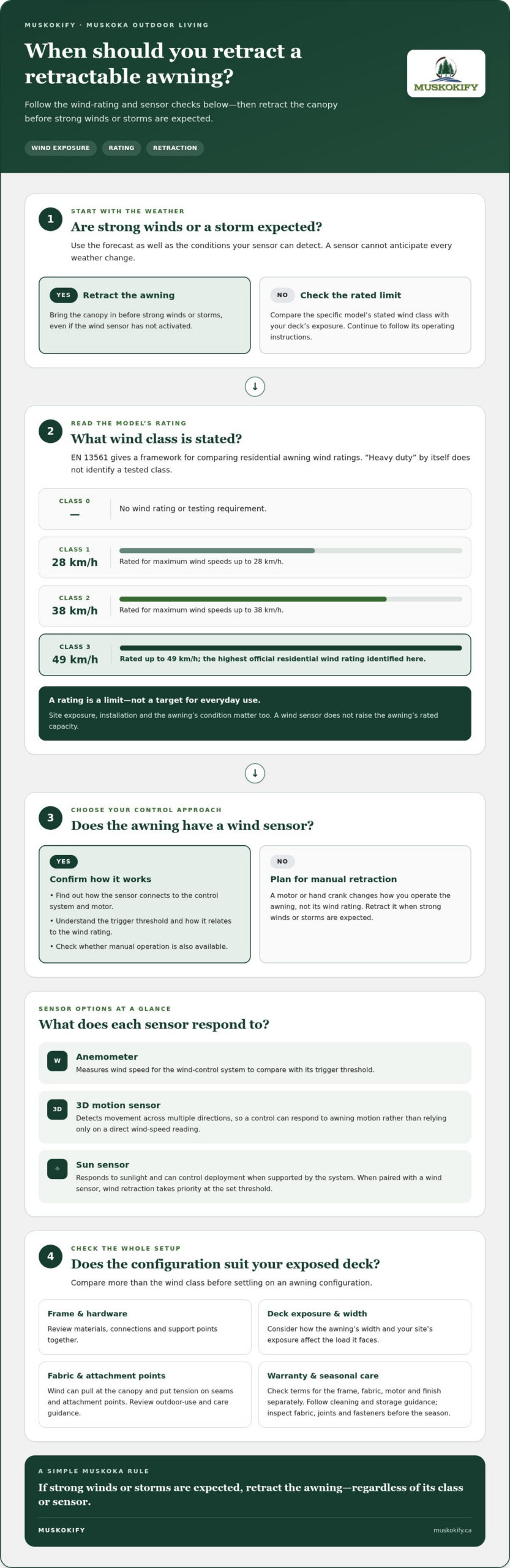
For heavy duty retractable awnings for high wind, prioritize a clearly stated wind rating and retract the canopy when strong winds or storms are expected. EN 13561 Class 3 is the highest official residential wind rating identified here, covering winds up to 49 km/h. Wind sensors can also automatically retract an awning when detected wind exceeds its set safe threshold.
That protection matters on an exposed Muskoka deck, where a calm afternoon by the lake can turn gusty. You still want an awning that suits your home, complements the view and is simple to operate. The right customization choices go beyond colour: dimensions, fabric, frame construction, pitch and manual or motorized operation all shape the finished space and how it fits your outdoor routine.
This guide explains how wind ratings and retraction habits affect performance, what to consider when selecting options, and how a professional site assessment can match an awning to your property. You’ll find practical decision points for choosing a suitable configuration and planning for Muskoka’s changing weather, so you can create inviting shade without overlooking wind exposure.
Key Takeaways
- Choose an awning with a clearly stated wind rating, and treat a wind sensor as an added safeguard rather than a reason to leave it extended in a storm.
- Compare frame materials and construction details to understand how the awning is designed to handle wind pressure.
- Consider how internal tension and adjustable pitch can affect the awning’s fit and day-to-day use.
- Assess the mounting surface and available clearance before settling on an awning configuration.
- Build a habit of retracting the awning when strong winds or storms are expected to help protect its fabric and frame.
Wind sensors and automatic retraction
On a Muskoka deck, wind sensors can trigger an awning’s motor when gusts reach its set threshold. They add a layer of protection, but your operating routine still matters.
Automatic Retraction Controls
A wind sensor detects conditions that meet its trigger setting and signals the awning’s control system. The motor then retracts the canopy, reducing how long it remains exposed. Before choosing a model, find out how the sensor connects to the controls and whether the awning can also be operated manually. Automatic retraction adds convenience, but it doesn’t replace retracting the awning before a storm.
Wind ratings help put sensor settings in context. Class 1 awnings are rated for maximum wind speeds up to 28 km/h, while Class 2 models are rated up to 38 km/h. Class 0 has no wind rating or testing requirement. These classifications describe different limits, so don’t treat a sensor as a way to raise an awning’s rated capacity.
Wind and Sun Sensor Options
Anemometers measure wind speed, giving a wind-control system a reading to compare with its trigger threshold. A 3D motion sensor detects movement across multiple directions, which can help a control respond to awning motion rather than relying only on a direct wind-speed reading. Ask how each model detects conditions and initiates retraction, then consider the exposure of your deck.
Sun sensors serve a different purpose: when supported by the system, they respond to sunlight and can control deployment. Pairing sun and wind sensors can balance shade with weather protection. For example, a sunny afternoon may call for shade, while a sudden gust prompts retraction. The wind response should take priority when conditions reach the set threshold.
Use these practical checks when comparing sensor arrangements:
- Confirm which sensor detects wind, and how its signal reaches the motor.
- Understand the trigger threshold and how it relates to the awning’s wind rating.
- Check whether the control includes a manual option for changing weather.
- Consider whether a sun sensor suits the way you use your patio.
Automatic controls can’t anticipate every weather change. A sensor reacts to conditions it detects, while a forecast may signal an approaching storm before wind reaches the trigger point. Retract the awning when strong winds or storms are expected, even if the sensor hasn’t activated. For a Muskoka property, awning options for outdoor spaces can be considered alongside the site’s exposure and your preferred control method.
Awning frame strength and durability
For Canadian homeowners, wind ratings help compare an awning’s tested resistance. EN 13561 Class 3 is identified as the highest official residential wind rating, covering winds up to 49 km/h.
Frame and Awning Material Durability
Frame strength depends on the materials, connections and support points working together. Durable materials can help the frame withstand strong winds, but even a robust frame relies on suitable installation. Compare the frame construction and hardware, then consider how the awning’s width and exposure affect the load it faces. A broad, exposed Muskoka deck presents different conditions from a sheltered patio.
Fabric needs attention, too. Wind can pull at the canopy and put tension on its seams and attachment points. Look for fabric intended for outdoor exposure, and review its care instructions. Choosing a motor or hand crank changes how you operate the awning, not its wind rating.
Warranty and Durability Criteria
A warranty clarifies which parts are covered and under what conditions. Read the terms for the frame, fabric, motor and finish separately, since coverage may differ by component. Check how the warranty addresses wind-related damage and the care required to maintain coverage. Retracting the awning before strong winds reduces its exposure, but doesn’t change its stated rating.
Durability also depends on regular care. Follow the manufacturer’s cleaning and storage guidance, and inspect the fabric, joints and fasteners before the season begins. These checks can help you spot wear before using the awning again.
Wind Ratings and Testing Standards
EN 13561 provides a useful framework for comparing residential awning wind ratings. Class 3 covers winds up to 49 km/h, making it the highest official residential class identified here. Treat that figure as a rating limit, not a target for everyday use. Site exposure, installation and the awning’s condition also matter.
Ask which wind class applies to the specific model and whether its rating is based on testing. Don’t assume that “heavy duty” alone identifies a tested class. Compare the rating with your property’s exposure, then follow the operating instructions for retracting the canopy.
Use these checks when comparing models:
- Match the stated wind class to your site’s exposure.
- Review frame, fabric and hardware as separate components.
- Read warranty terms and care instructions before choosing.
Awnings should be retracted when strong winds are expected, even if the frame is designed for wind pressure. Compare awning options for your outdoor space with your deck’s exposure and preferred operation method.
Internal tension systems and adjustable pitch
An awning’s internal tension system supports the fabric as it opens. Adjustable pitch changes the canopy angle, helping tailor its shade and projection to your deck or windows.
Tension and pitch are related, but separate, adjustments. The arms support the fabric as the awning extends, while the pitch sets its downward angle. A suitable setup positions the canopy for your space, but adjustment is no substitute for retracting it in strong winds. On a Muskoka patio, consider how the sun moves across the deck and where you want shade throughout the day.
Projection describes how far the awning extends from its mounting point. Greater projection can shade more of a seating area, while a shorter reach may suit a narrow balcony or window. For window awnings, consider the window’s position and how much shade you want indoors. Before choosing, compare the awning’s dimensions with the area to cover, and note the location of posts, railings and doors.
Slope adjustment lets you change the canopy angle rather than its extension alone. One heavy-duty awning model has a slope adjustment range of 5 to 45 degrees. That range illustrates why the model’s stated specifications matter: not every awning has the same adjustment. A steeper pitch changes the canopy’s angle; it does not establish a higher wind rating.
When comparing an ADVANING awning, identify the exact model and read its pitch-adjustment instructions. Look for the stated adjustment range, how to change the angle, and whether the instructions specify manual operation. Don’t assume the brand name alone tells you the available projection or pitch. These details help you decide whether the canopy will suit a window, compact terrace or broader deck.
For manual adjustments, follow the model’s instructions and make changes only as directed. Keep the fabric evenly supported, and stop if the mechanism binds or the canopy looks uneven. If one side sits lower after adjustment, for example, return to the instructions rather than forcing the arm. This check helps protect the fabric and moving parts from unnecessary strain.
Before settling on a configuration, use these steps:
- Measure the area you want shaded, including window or deck projection.
- Compare the model’s pitch range with the angle your space needs.
- Read the adjustment and operation instructions for that specific awning.
- Keep wind limits separate from pitch and projection choices.
A considered pitch can transform how shade falls across an outdoor space, but the wind rating and operating guidance still determine how to use the awning. Match the projection and slope to your layout, then retract the awning when strong winds are expected.
Mounting surfaces and installation requirements
Mounting strength depends on the surface, attachment points and awning design. In Canada, building-code and municipal permit requirements can depend on the project, so confirm local requirements before installation.
Mounting Surface Requirements
Start by identifying the surface that will support the awning: a wall, fascia or other structure. The mounting area must provide suitable support for the system and its expected loads. An awning model’s clearance requirements also affect placement. For example, one heavy-duty model requires 8-1/2 inches of vertical space below the eave. With its weather protection hood, it requires 10-1/2 inches of vertical wall mounting space.
Measure available clearance and note obstacles such as doors, windows and rooflines. A professional assessment can account for the surface, mounting position and intended projection before work begins. This preparation helps homeowners plan an installation that fits the house and backyard layout.
Wall Mounting and Professional Installation
Wall-mounted awnings transfer their loads through the mounting bar and fasteners into the supporting structure. The wall’s construction and condition matter as much as the awning itself. A professional installer can assess the mounting area, confirm clearances and position the unit to suit the opening. At a cottage with limited wall space, these details help avoid conflicts with windows or trim.
Installation timing depends on project details such as site access, the selected model, mounting conditions and preparation. A site with clear access and suitable mounting space requires different work from one that needs additional assessment. Plan for maintenance, too: follow the model’s care instructions and inspect the fabric, frame and visible fasteners before seasonal use.
Mounting Types and Wind Resistance
Wall-mounted awnings rely on a suitable building surface and secure attachment. Freestanding designs depend on their own supports and anchoring. A cassette is a housing that encloses the retracted awning; it doesn’t, by itself, establish wind resistance. Compare each model’s stated rating and installation requirements rather than assuming one mounting type is automatically stronger.
For any configuration, installation quality and the supporting structure affect how the system handles wind pressure. A wall-mounted unit needs a suitable wall; a freestanding unit needs stable support. A cassette can protect retracted fabric from exposure, but it doesn’t make an extended canopy safe in strong winds. Follow the model’s operating guidance.
Before installation, use this short planning list:
- Measure mounting clearance, including the model’s eave or hood requirements.
- Identify the supporting surface and note visible obstacles.
- Review municipal requirements and the model’s installation instructions.
- Plan seasonal inspection and fabric care around the manufacturer’s guidance.
Retracting awnings before strong winds or storms
Choose a model with a stated wind rating, then retract it before strong gusts or storms arrive. EN 13561 Class 3 is the highest official residential wind rating identified here, covering winds up to 49 km/h.
Retractable awnings can withstand some wind pressure, but they should be retracted in strong winds or storms. Strong winds are the leading cause of retractable awning damage. A 20-foot awning presents a large surface to the wind, much like a kite. A gust of 30 km/h can generate thousands of pounds of lift, while a 50 km/h gust can create more damaging impact force than sustained wind at 30 km/h.
Risk can start before a severe storm arrives. Retractable awnings may be at risk of damage when wind speeds reach 20 to 25 mph. Retract yours whenever sustained winds exceed 30 km/h or gusts become unpredictable. Retract it when winds are expected to exceed 50 km/h, and don’t wait for an automatic sensor if a storm is approaching.
Which heavy-duty retractable awning models are rated for high wind resistance? Look for a model with a clearly stated tested wind class, such as EN 13561 Class 3, rated up to 49 km/h. The available facts do not tie that rating to a specific named model, so compare each model’s own rating rather than relying on “heavy duty” wording alone.
Plan daily use around your outdoor space and its exposure. A sheltered backyard may face different gusts from an open, lakeside deck. If you’re away from a seasonal cottage, a remote control can make operation easier, but it doesn’t replace preparing for forecast weather. Retract the awning before leaving if wind conditions may change.
Use this practical sequence when conditions begin to shift:
- Check the forecast for sustained winds, gusts and storm warnings.
- Retract the canopy when sustained winds exceed 30 km/h or gusts become unpredictable.
- Retract it before leaving the property if strong winds are expected.
- After the weather passes, inspect the fabric, arms and frames before extending it again.
Retracting an awning shields it from the full force of high winds and can reduce damage risk. Make this part of your routine before storms, not a response after gusts reach the patio. For advice on selecting and planning an awning for your outdoor space, discuss your awning plans with Muskokify.
No named models are identified; a suitable high-wind rating to look for is EN 13561 Class 3, which covers winds up to 49 km/h.
Muskokify: Sunspace Sunrooms
Muskokify can help you create a more sheltered outdoor living area with Sunspace Sunrooms. If you’re considering an enclosed space instead of an open deck, a three-season or four-season living area can create a comfortable transition between home and the Muskoka landscape.
For a lake-facing deck, Glass Railings can preserve open views, while Aluminum Railings offer another way to define the edge of your outdoor space. Motorized Screens provide adjustable screening for greater control over the space.
Explore Sunspace Sunrooms to see how an enclosure may suit your home or cottage. Contact Muskokify to discuss your outdoor living plans.
Shape an outdoor space that suits your cottage
Choosing a heavy-duty retractable awning for high winds is one part of planning how to enjoy your Muskoka property. Consider how you want your outdoor space to feel across the seasons and how its layout connects with the landscape. Clear priorities can guide your design decisions.
Think about the view you want to preserve, where you’ll spend time outdoors and how the space should function as the weather changes. These details can help shape a solution that feels at home beside the lake or among the pines.
Ready to explore the possibilities for your home or cottage? Contact Muskokify to discuss your outdoor space and take the next step toward enjoying it on your terms.
Frequently Asked Questions
What Customization Options Are Available for Retractable Awnings?
Choose options based on how you use the space, not appearance alone. Note where you sit, which windows need shade and when sunlight reaches the deck. A dining area used at midday, for example, may need different coverage from a lounge used in the evening. Then compare fabric appearance and operating preferences with the home’s exterior and how you use the patio.
Are retractable awnings safe in high winds, and what wind speeds can they withstand?
Awnings are safe to use within the operating limits set for their particular model, but no single wind speed applies to every awning. The rating, size, installation and exposure all affect performance. A cottage beside open water can face different conditions from a sheltered backyard. Follow the model’s instructions instead of assuming all awnings share the same threshold.
Are wind sensors and automatic retraction systems reliable for protecting awnings?
Wind sensors are useful safeguards, but regular checks help keep the controls ready to respond. Before the outdoor season, test the remote and control functions as directed in the product instructions. Keep the sensor unobstructed, and make sure household members know how to operate the awning manually. If the property sits empty between visits, include the controls in your seasonal opening routine rather than relying on automation alone.
What are the best materials and frame designs for a wind-resistant retractable awning?
Choose a complete model designed for outdoor use rather than judging it by one material alone. The frame, moving arms, fabric and connections need to work as a system. Ask for the model’s operating instructions and care guidance, then review how to store and maintain the canopy. These documents also help you understand the limits of the specific configuration you’re considering.
How should a retractable awning be anchored to brick, concrete, or wood in windy areas?
Use anchoring hardware suited to the supporting material and the awning’s installation instructions. Brick veneer may conceal a different structure behind it, while concrete and wood each need appropriate fastening methods. Don’t choose hardware based on the outer surface alone. A qualified installer can identify the substrate and select an attachment method for that wall, helping prevent damage from unsuitable drilling or fasteners.
What does professional installation of a heavy-duty retractable awning cost in Canada?
Installation planning starts with documenting the opening, mounting surface, access and clearance around the proposed awning. These details shape the work plan for each property. A high deck with limited access, for example, needs different preparation from a ground-level patio. Before installation begins, clarify the work sequence, required site preparation and how the selected awning’s instructions affect placement.
What maintenance and precautions help prevent wind damage to retractable awnings?
Follow the manufacturer’s care instructions for cleaning and storing the fabric, especially after wet weather. Let the canopy dry as directed before storing it, and clear leaves or other debris that could collect around the frame. At the start of the season, operate the awning through its normal range and watch for uneven movement. If it binds, stop and follow the product guidance before using it again.