
Sunroom Financing Options in Ontario
A HELOC may be an option for homeowners exploring sunroom financing in Ontario, depending on their circumstances. It can be worth considering when you want to use home equity to finance a project while choosing a repayment approach that fits your plans.
Look beyond the monthly payment. Approval requirements, repayment terms, promotional offers, and prepayment penalties can all affect what borrowing means for your household over time.
This guide compares HELOCs with other financing options, explains what lenders may consider during approval, and highlights terms to review before you commit. You’ll also learn how to assess promotional rates alongside the repayment conditions that follow, and how to plan financing around the sunroom you want to enjoy.
Key Takeaways
- Understand how credit history, income and property eligibility can shape approval for a figure HELOC; funding may be available in as few as 5 business days.
- Compare fixed-APR repayment plans by looking at payment structure, borrowing terms and how each fits your household budget.
- Read promotional and deferred-interest terms closely so you know when payments begin and what happens when the offer ends.
- Weigh contractor financing against bank financing, including how each option handles approval, repayment and the project timeline.
- Review prepayment terms before borrowing, and explore Muskokify’s Sunspace Sunrooms when you’re ready to plan an enclosed living space.
Credit approval and FICO score requirements
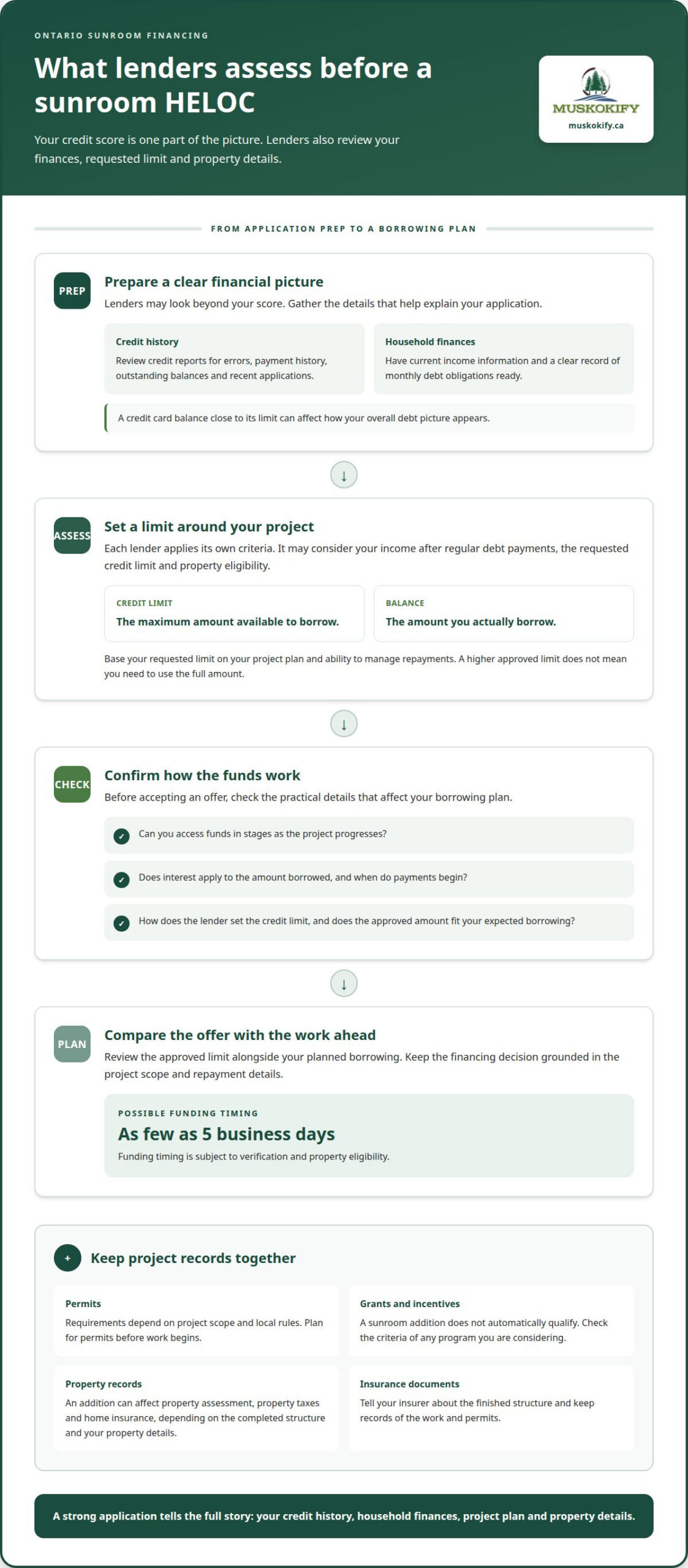
Ontario lenders don’t use one universal FICO score to approve every sunroom loan. Each lender weighs its own credit criteria alongside your income, debts, property details, and requested credit limit. A strong application presents these details clearly rather than relying on one score alone.
Review your credit reports and correct any errors before applying. Lenders may assess your payment history, outstanding balances, and recent applications. For example, a credit card balance close to its limit can affect how your overall debt picture appears. Prepare current income information and a clear record of your monthly obligations.
Approval also depends on whether the requested amount fits the lender’s rules and your finances. A lender may consider your income after regular debt payments, the proposed borrowing limit, and property eligibility for a figure HELOC. Funding may be available in as few as 5 business days, subject to verification and property eligibility.
Ask how the lender sets your credit limit, not just whether you qualify. The limit is the maximum amount available; your balance is what you actually borrow. With a HELOC, the available amount may depend on the property and the lender’s assessment. Base your requested limit on the project plan and your ability to manage repayments.
Before accepting an offer, compare the approved limit with your expected borrowing. A higher limit doesn’t mean you have to use the full amount. Check whether funds can be accessed in stages, how interest applies to the amount borrowed, and when payments begin. These details can shape your plan as project needs change.
For an Ontario sunroom addition, permit requirements depend on the project scope and local rules. Plan for permits before work begins, and keep related documents with your financing records.
A sunroom addition doesn’t automatically qualify for a government grant or incentive. Eligibility depends on the program’s criteria, so compare your planned work with the specific terms of any program you’re considering.
A sunroom can affect your property assessment, property taxes, and home insurance coverage. The impact depends on the completed addition and your property details. Tell your insurer about the finished structure, and keep records of the work and any permits.
Use this preparation list before applying:
- Gather current income and debt details.
- Review credit reports for errors and balances.
- Set a borrowing limit based on your project plan.
- Keep permit, tax, and insurance records organized.
These steps help you compare financing terms with the work you plan to complete. A FICO score is only one part of a lender’s decision; your application and property details matter too.
Fixed-APR repayment plans
A fixed annual percentage rate (APR) can make scheduled loan payments more predictable during the fixed-rate period. Compare the full repayment terms, not just the advertised rate.
Reduced-Rate APR Plans
A reduced-rate APR plan offers a lower rate for a stated period or under stated conditions. Check when the reduced rate starts, how long it applies, and what rate follows. For example, keeping the discount may require automatic or timely payments. Compare those conditions with your monthly budget.
Check whether the reduced rate stays fixed throughout its stated period or can change. Even a fixed introductory rate may rise when that period ends. Note the end date, the later rate, and how the agreement describes rate changes. This shows the repayment path beyond the opening offer, rather than leaving you to judge the plan by its initial rate.
Rates, Fees, and Repayment Terms
There is no single typical interest rate or repayment term for every sunroom loan in Canada. Lenders set terms according to the financing product, your application, and the repayment structure. Compare written offers for APR, payment frequency, term, and conditions before choosing.
APR provides a common measure for comparing credit offers. Read the agreement to understand how the rate applies and whether it can change. Check whether the stated APR is fixed for the full repayment period or only an introductory interval. Compare the lender’s written offer with your household budget as you assess each payment schedule.
With a fixed-rate instalment loan, the lender sets a repayment schedule for the amount borrowed. Your payment amount and timing depend on the agreement’s rate, balance, and term. Compare the total repayment amount in the offer with each scheduled payment. A longer term can lower individual payments but extend the time you remain committed.
A fixed APR differs from a variable rate, which can change under the terms of the agreement. Read the rate-change conditions and consider how a change could affect payments or the repayment period. For a HELOC, check whether the rate applies to the amount drawn or the full available limit. This distinction matters if you access funds in stages as the project progresses.
Before accepting an offer, use this comparison checklist:
- Record each offer’s APR and whether it is fixed.
- Note when a reduced rate ends and what rate follows.
- Compare payment timing, term, and total repayment.
- Review conditions tied to any rate discount.
A side-by-side review makes differences easier to see. Choose based on the full written terms and a payment plan that leaves room for household priorities.
Promotional no-payment and deferred-interest plans
Promotional offers may delay required payments or change how interest applies for a stated period. Read the agreement closely, because these features don’t always come together.
No-Payment Promotions
A no-payment promotion pauses required payments during its stated promotional period, but it doesn’t necessarily stop interest from accumulating. For example, an agreement may defer payments while interest continues to accrue on the balance. Check the promotion’s start and end dates, when regular payments begin, and how the balance is treated during the pause.
Plan for the first payment before accepting the offer. Mark the promotion’s end date in your calendar, and consider setting money aside during the pause. Read how missed or late payments affect the promotion. The agreement may describe conditions that change your payment obligations, so understand them before relying on deferred payments.
Deferred-Interest Plans
With deferred interest, interest may accrue during the promotional period even if you make no payments. The agreement explains whether accrued interest is waived when you meet its conditions or added to your balance when the period ends. That difference affects how the plan works after the promotion.
Find the exact payoff deadline and payment rules in the agreement. For example, making only the required minimum payment may leave a balance at the deadline. If the offer applies accrued interest then, the amount you owe can increase. Work out the payment schedule needed to clear the balance by the stated date, and note what happens if you miss it.
Interest-Free Payment Plans
An interest-free plan applies no interest while you meet the agreement’s terms. Check whether that rate lasts for the full repayment term or only during a promotional period. Review payment dates, required amounts, and the conditions for keeping the plan interest-free.
For example, a plan may require equal payments on set dates. Depending on the contract, a missed payment could affect the offer. Confirm whether automatic payments are required and what happens if a payment fails. Keep the written offer and payment schedule together so you can track each due date.
Compare offers using the same details:
- Identify the promotional end date and first payment date.
- Check whether interest accrues during a payment pause.
- Read how missed payments affect the promotion.
- Work out the payment schedule to clear the balance by the deadline.
- Note the rate and repayment terms that apply afterward.
Distinguish “no payment” from “no interest” when comparing plans. One describes when payments are due; the other describes how interest applies. A promotion may include one feature without the other. Use the written agreement to understand your obligations after the promotional period instead of assuming a payment pause also pauses interest.
Contractor financing compared with bank financing
Contractor-arranged financing and bank financing differ in how you apply, compare terms, and coordinate payments. For a sunroom project, review the written credit agreement separately from the construction agreement.
With contractor-arranged financing, the contractor connects your application with a financing provider, which makes the credit decision and sets repayment terms. This can keep project planning and financing discussions closely aligned. Read both agreements carefully: the financing contract covers borrowing, while the construction contract covers the work, schedule, and payment milestones.
Bank financing starts with a product offered by your bank or credit union. Options may include a personal loan, line of credit, or HELOC, each with a different structure. A personal loan sets an amount and repayment schedule; a line of credit lets you borrow within an approved limit. A HELOC uses home equity as security, subject to lender approval.
Compare both routes using the same project details. For example, if construction payments happen in stages, ask how each financing arrangement handles the timing. A lump-sum loan can provide funds upfront, while revolving credit lets you draw funds as needed under its terms. Check whether the construction contract requires deposits or progress payments, then match those dates with available funds.
Don’t compare offers by monthly payment alone. Record the APR, payment schedule, term, fees, and total repayment shown in each agreement. A longer term can lower scheduled payments but extend repayment. For contractor-arranged financing, identify the actual lender and read its contract. For a bank offer, review the account terms and any security attached to the borrowing.
Keep project and credit obligations distinct. If construction timing changes, the loan agreement may still require payments on its original schedule. If you borrow from a bank before finalizing work details, track the approved amount and planned withdrawals. In either case, don’t assume financing approval automatically changes construction milestones.
Use this comparison checklist before choosing:
- Identify the lender and type of credit.
- Compare APR, fees, repayment term, and total repayment.
- Match payment dates to construction milestones.
- Check whether funds arrive as a lump sum or through draws.
- Read the financing and construction contracts separately.
For example, a bank HELOC and a contractor-arranged instalment loan may suit different cash-flow plans. The better fit depends on how you want to access funds, the terms offered, and your repayment approach. Save each written offer and compare the same details side by side before signing either agreement.
Prepayment penalties
Before financing a sunroom, consider repayment pressure, project delays, changing borrowing needs, and prepayment charges. Review the agreement’s early-payment clause before signing to see whether paying ahead of schedule triggers a fee.
A prepayment penalty is a charge for paying some or all of a loan ahead of schedule. It may apply when you refinance, sell your home, make a large extra payment, or clear the balance early. The wording matters: one contract may allow extra payments, while another may limit them or attach conditions.
Find the prepayment terms in the lender’s written agreement. Look for the permitted extra-payment amount, timing limits, and how the lender calculates any charge. If the wording refers to a percentage, a set fee, or interest, identify the balance and period used to calculate it. Don’t assume “open loan” or “flexible payments” means unlimited penalty-free repayment.
Consider a simple example: you receive funds from another source and want to clear your sunroom loan early. If your contract limits lump-sum payments, paying beyond that limit could trigger a charge. Even when no penalty applies, early repayment may change scheduled payments or account terms. Ask the lender to show how the agreement treats your planned payment.
Prepayment flexibility matters when your plans could change. A cottage owner might sell a property, refinance, or receive funds from another source before the scheduled end date. A fixed-term loan with restricted early payments may be less suitable than credit with flexible repayment terms. Compare the flexibility clause alongside the APR and payment schedule.
Also consider project timing. If construction payments shift, you may borrow in stages or hold funds longer than expected. Your financing agreement can still require payments on its stated dates. Keep the construction and loan schedules together, and note when extra payments are permitted. This helps prevent a timing change from becoming a contract surprise.
Before accepting an offer, record these details:
- Whether full or partial early repayment is permitted.
- How the contract calculates any prepayment charge.
- Whether extra payments have limits or set dates.
- How early repayment affects the remaining balance.
- Which steps the lender requires before making a lump-sum payment.
Keep a copy of the agreement and the lender’s written explanation. Before making extra payments, compare your plan with the contract. This makes the trade-off clear before you commit to borrowing for the addition.
For a sunroom project, discuss your design and schedule alongside your financing plans. Talk with Muskokify about planning your sunroom project as you organize the next steps.
Muskokify: Sunspace Sunrooms
Muskokify helps you plan a sunroom that suits your home, cottage, and intended use. Explore Sunspace Sunrooms when you’re ready to turn your financing plan into a defined project, from a bright Muskoka retreat to a more sheltered space for changing seasons.
Consider how you want the room to feel and function. Will you use it for seasonal relaxation or everyday living? How should its layout frame lake, forest, or garden views? Clear answers help shape a design suited to your property and lifestyle. Where they fit your plans, Glass Railings, Aluminum Railings, or Motorized Screens can complement an outdoor living space.
Contact Muskokify to discuss your sunroom project.
Plan the space around your next step
Before moving ahead, picture how you want your home or cottage to work in every season. Note the space you want to enclose, how you’ll use it, and the views you hope to preserve. A clear project brief gives you a practical starting point as you consider sunroom financing options in Ontario.
Bring your vision and financing plan together. Keep the design scope, construction timing, and repayment commitment in view as you decide what feels manageable for your household. The goal is a sunroom that suits your property and the way you want to enjoy it, from quiet mornings overlooking the lake to sheltered evenings after the weather turns.
When you’re ready to discuss the sunroom itself, contact Muskokify about your project. You can shape the next step with a clear sense of the space you want to create.
Frequently Asked Questions
What financing options are available for sunroom projects in Ontario?
Ontario homeowners can compare personal loans, bank lines of credit, HELOCs, mortgage refinancing, and contractor-arranged financing. The right sunroom financing options in Ontario depend on whether you prefer a set repayment schedule or flexible access to funds. For example, staged construction payments can make access timing important. Compare the loan agreement with your project schedule, and account for permit planning and construction payments.
Can Ontario homeowners use a HELOC or home equity loan to finance a sunroom?
Yes, homeowners can use a HELOC or home equity loan if they meet the lender’s approval requirements. A HELOC generally provides access to credit up to an approved limit, while a home equity loan provides a set amount under its repayment terms. Since both use home equity, consider how borrowing affects your home-secured debt. Match the amount requested to your project plan rather than automatically borrowing the full available limit.
Can a sunroom addition qualify for a mortgage refinance or construction loan in Ontario?
Yes, refinancing or construction financing can be considered for a sunroom, subject to the lender’s product rules and your application. Refinancing replaces or changes existing mortgage financing, while construction financing is arranged for building work under the lender’s terms. Ask how the lender assesses the project scope, property, and construction schedule. For a cottage near Huntsville or Gravenhurst, prepare a clear project description and expected payment timing.
How do contractor financing plans compare with personal loans and home equity financing?
Contractor-arranged plans connect the project with a financing agreement, while personal loans and home equity products come through a lender you approach directly. Compare the financing provider, APR, fees, repayment schedule, and payment conditions. For example, if you expect payments at construction milestones, check how each option releases funds and aligns with those dates. Review the credit agreement separately from the construction contract so each obligation is clear.
What documents and credit requirements are needed to finance a sunroom in Ontario?
Lenders commonly assess identity, income, existing debts, credit history, and the requested borrowing amount. Prepare income records, details of monthly obligations, and a project estimate or contract describing the proposed work. Secured borrowing can also involve information about your property and mortgage. There is no single FICO score threshold that applies to every lender; each uses its own approval criteria. Keep your documents consistent and current before applying.